I Have a Confession to Make About My Landscape Photography
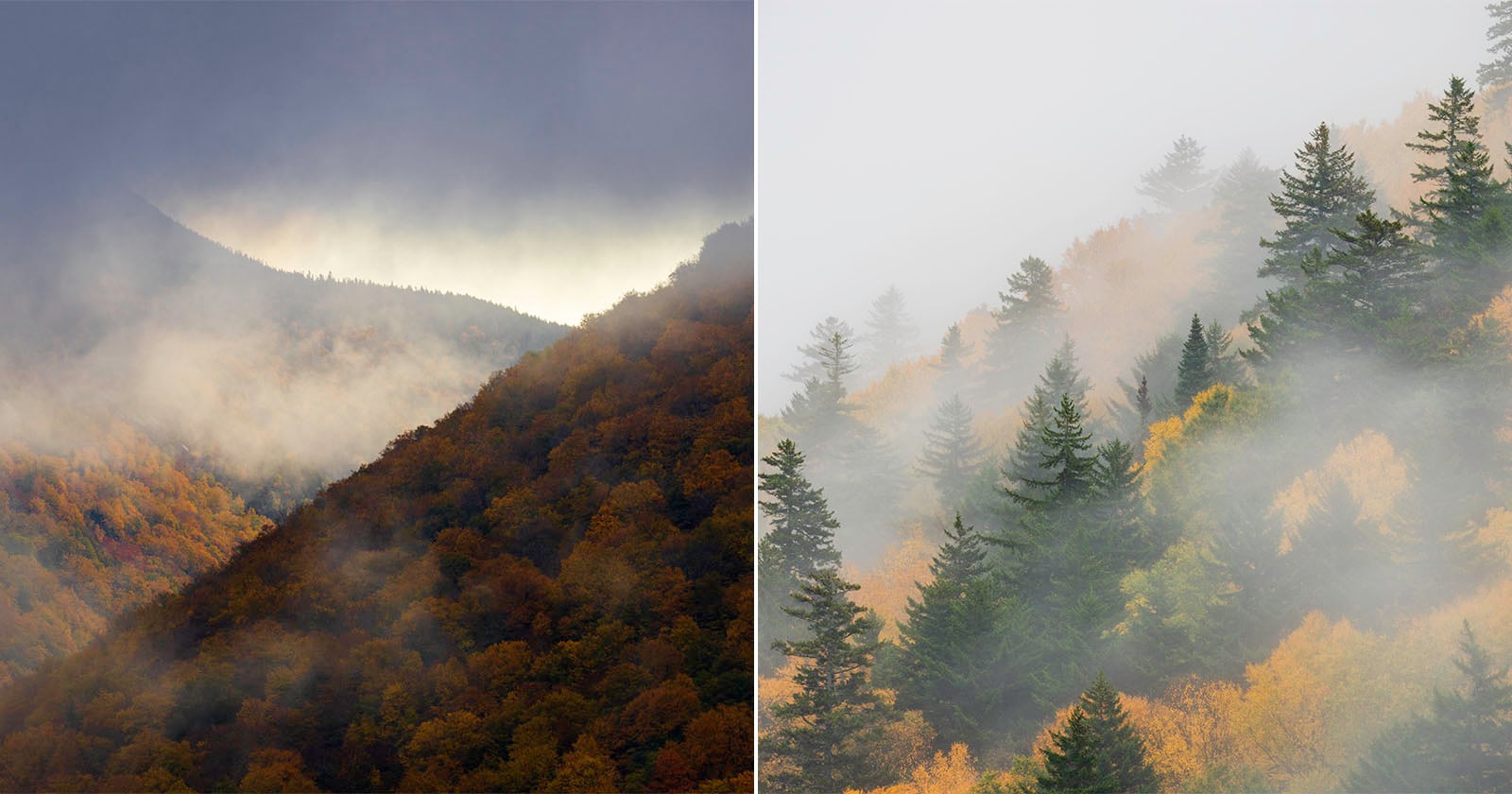
Foliage season is in full swing here in New England, and so far, my wide-angle lens has spent far more time in my bag than attached to my camera. My name is Jeremy, and I’m addicted to telephoto lenses for landscape photography.
I’m far from the first photographer to spill ink about the virtues of longer lenses for landscape photography. But after I nearly exclusively used Sony’s new 400mm f/4.5 GM OSS lens on my Sony a7R VI during a trip to the White Mountains in New Hampshire over the weekend, I figured it was as good a time as any to share my two cents on the topic and reckon with the fact that I actually prefer longer lenses to traditional “landscape lenses.”
I took 134 photos and settled on 20 selects to post-process, a shockingly high hit rate for me. Of those 20 selects, I shot 16 with the Sony 400mm f/4.5 GM. I shot the other four with the Sony FE 24-105mm f/4 G zoom lens at focal lengths ranging from 43mm to 105mm. Tough day for wide-angle landscape photography.
When I look through my library, this isn’t even unusual. While a 24-70mm, 24-105mm, or 24-120mm lens is certainly a “must-have” part of any landscape photography kit and the sort of lens I’ve always owned, I’m surprised by how rarely I use the wide end of any zoom lens.
Plenty of photographers create incredible landscape work at ultra-wide and wide-angle focal lengths, but I’m rarely among them. Well, I arguably never do “incredible” work behind the lens at all, but my own favorite shots are often in the 40-100mm range and beyond.
On this particular expedition, wide-angle focal lengths had a few distinct disadvantages. I started the day with a night hike up to Artists Bluff in Franconia Notch State Park to catch the sunrise over the absolutely stunning Echo Lake with my partner. She’s a trooper, somehow on board with my cruel plan to leave the house at 3 AM to “get the good light.” Non-photographers rarely understand or care about the light, but she cares on my behalf. For that I am eternally grateful, albeit devoid of excuses to sleep until a normal hour.
It’s a great viewpoint, but its beauty means it’s very popular. Given that it was a Saturday morning, I shared the spot with a bunch of other people.
Sometimes landscape photography, often a solitary adventure, is better when you share it with strangers. However, more people are awful in terms of practicality. A wide-angle perspective meant having a bunch of people in the frame, and that’s not at all my style of landscape work.
In this situation, a longer focal length let me eliminate distracting hikers from the frame. However, in nearly all situations, no matter who else is around, using a longer focal length removes distractions.
Very rarely do I find a composition improved by including more. Nearly always, photos are better because I have fewer things in the frame. In many landscape scenarios, it’s more practical to get a narrower view by using a longer lens than to “zoom with your feet.” Especially in this case, since zooming with my feet would have meant plummeting to my death. Talk about putting a damper on my Saturday morning photo excursion.
I’ve made plenty of landscape photos I like with a wide-angle lens over the years, often relying heavily on interesting foreground elements. But it’s very challenging to do consistently. Most foreground elements just aren’t that interesting, although perhaps that’s a skill issue. I find longer lenses a cheat code of sorts, letting me quickly simplify a scene and focus on the most interesting subjects.
Autumn landscape photography is a deceptively tough test of many photography skills. You’d think that the prettier a scene, the easier it is to photograph. However, the scenery and colors can be so overwhelming and beautiful that they serve as a compositional siren song. They pull me in and make me forget that a good photo must be more than just a photo of something good.
I spent years taking fall photos that, upon reflection, are just pictures of pretty things. There’s nothing wrong with that, but at some point, I realized that maybe I’d feel more satisfied by more focused shots, “smaller” shots rather than the most colorful ones that had the most going on in the frame. There can be too much of a good thing.
I’ve learned this same lesson many times over across different sub-genres of landscape photography. More is rarely better when it comes to elements in a photo. A telephoto lens makes it much easier to reduce the number of things in a scene and zero in on exactly what you like about a shot.
From atop Artists Bluff in the wee hours of Saturday morning, what spoke to me was fog, depth, light, and texture — smaller groups of trees rather than an entire forest. Individual shapes rather than the whole vista. Less is often more in composition, and it’s easier to embody “less is more” with longer lenses.
I’m not saying that the other photographers, nearly all of whom were using wide-angle lenses based on my curious sideways glances, didn’t capture better photos than me. I assure you, they definitely could have. Perhaps they have incredible, enviable 24mm and 28mm photos I’d love to have in my portfolio. Maybe someone even pulled off what I maintain is an impossible feat: a truly killer ultra-wide landscape shot.
But on Saturday and so many other days in recent years, the photos I am most happy with, the photos I enjoyed framing and capturing the most, were shot with a telephoto lens. At some point, it’s no longer the exception but the rule: I’m a telephoto landscape photographer. Telephoto lenses are landscape lenses.
I think all landscape photographers, even those who love their wide-angle lenses, should think about busting out a telephoto lens the next time they’re out in the field. You may be surprised by how many great, smaller photos you can find hidden in your wide-angle compositions. Simplify the scene with a longer lens and see how it goes. If nothing else, it’s fun to experiment. I certainly had fun.