Webb Photographs One of the Most Beautiful Gravitational Lenses
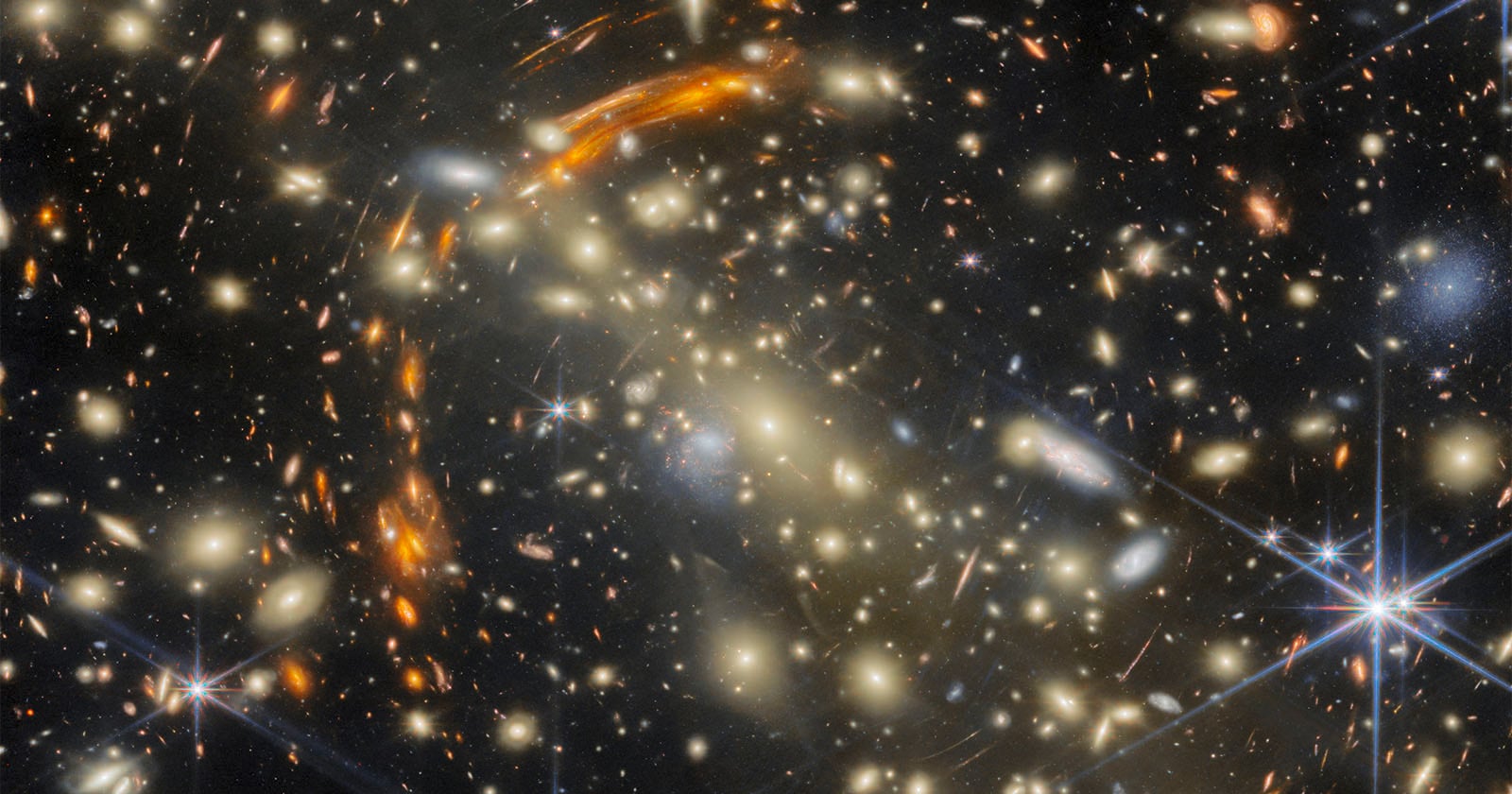
The newest NASA/ESA/CSA James Webb Space Telescope (JWST) Picture of the Month is among the best and most powerful examples of gravitational lensing ever seen.
ESA Webb describes the newest JWST Picture of the Month as a “cosmic house of mirrors,” noting that the galaxies featured in the image are “warped and multiplied” as though they stepped into some galactic carnival.
These warped galaxies, part of the galaxy cluster MACS J0454.1-0300, are extremely far from Earth. While the orange galaxies on one side of the cluster are even more distant, MACS J0454.1-0300 is five billion light-years away. The galaxies in Webb’s photo are being viewed as they were when the Universe was about eight billion years old. It’s a cosmic time machine.
Webb and other space telescopes like Hubble can view the far distant Universe because of gravitational lensing. The same phenomenon that warps the galaxies in the frame is also what makes them visible at all.
Gravitational lensing occurs when a celestial body, like a galaxy cluster, is so massive that it literally bends the light traveling from behind it relative to the viewer.
“According to Einstein’s general theory of relativity, time and space are fused together in a quantity known as spacetime. Within this theory, massive objects cause spacetime to curve, and gravity is simply the curvature of spacetime,” ESA Webb writes. “As light travels through spacetime, the theory predicts that the path taken by the light will also be curved by an object’s mass. Gravitational lensing is a dramatic and observable example of Einstein’s theory in action. Extremely massive celestial bodies such as galaxy clusters cause spacetime to be significantly curved. In other words, they act as gravitational lenses.”
Importantly, a “gravitational lens” also acts like a magnifying glass. It makes it possible to photograph objects that would otherwise be far too distant and faint to witness. Scientists use this phenomenon to great effect with telescopes like Webb. Paired with Webb’s huge 6.5-meter primary mirror, scientists using JWST have consistently set new records for the most distant galaxies ever observed, which is another way of saying that Webb has enabled humanity to see farther into the history of the Universe than ever before.
In Webb’s latest Picture of the Month, another interesting phenomenon is on full display. Gravitational lensing can create double or even quadruple images.
“Under certain conditions, multiple images of the same galaxy can appear. It’s rare to see four or more images of the same galaxy, as this requires the position of the background object and the shape of the massive foreground object to be just so. Because the requirements are so particular, this phenomenon is only seen in 10–20% of galaxy clusters,” ESA Webb says.
This “rare configuration” is visible twice in Webb’s new photo. This is the first time that has ever happened with a single galaxy cluster.
Another interesting note: some locations in gravitationally lensed areas have been magnified by a factor of 300, which is staggering.
Webb is not the first space telescope to peer at MACS J0454.1-0300. The Hubble Space Telescope captured the same area 12 years ago. Hubble’s image helps illustrate just how advanced Webb’s photographic capabilities are, as the two shots could hardly look more different.
“The new Webb image reveals hundreds of galaxies missing from the earlier image. These galaxies were there all along, but Webb is much more sensitive to their much redder light,” ESA Webb says.
Image creditsESA/Webb, NASA & CSA, L. Furtak, S. Fujimoto