Running on Film with the Hasselblad XPan
This editorial photo shoot began with a simple idea, a question even: could a running sequence shot on the Hasselblad XPan create an editorial story in only a few frames?
I asked my friend Maud to be the subject. She works mainly as a sports model, and we both wanted to create something that fit her current career path and adds strong, story-driven images to her portfolio. Therefore, the challenge was set out to create a high-paced editorial series on a camera that is slow and deliberate by design.
Editorial photography lives at the intersection of narrative, mood, and context. It is often used in magazines and long-form features, and it often works best when the images work as a sequence rather than as isolated portraits. I had shot for magazines before, but I had never tried a movement-led story on the XPan. The mood of running had to be set in only a handful of frames. The sum of the images needed to feel bigger than each individual image. I will not lie, that made me nervous, whether or not it made it into a magazine.
This shoot mattered because it was both a technical test and a creative step for me. I wanted to trust a recently repaired XPan on something important and, at the same time, push myself toward more context-driven editorial work.
Additionally, I like putting people in places where they feel naturally at ease. Not every kind of shoot fits every person, even when someone is versatile. You can tell when a person is in their element. With Maud, I wanted to stay close to who she is and show her strength through running rather than styling her into something that did not feel honest.
Running has many layers. There is movement, clothing, stretching, and the mental space that comes with it. It can be social, yet it is often quite solitary. For this project, I wanted to show urban running rather than trail running. Urban running lets you place fluidity of movement of the idea thereof against hard lines and strong concrete shapes. That contrast between the city and the body was the key idea.
The Hasselblad XPan is not the obvious camera to bring to a sports-related shoot. It is slow to work with, and it slows me down too. Sports photography usually rewards speed and large numbers of frames. Here I had one roll of film and a camera that does not show you instant feedback. I could not check every frame as I went. Oddly, in a completely new setting and with those limits, I got more motivated, and the fear slowly eased away with time. The limitations forced me to commit and accept that I would miss some moments along the way. Especially because this camera does not allow autofocus, everything came down to great collaboration between the model and me in order to get the shot in the planned spot with the right posture.
The creative direction was built around sunrise, stillness, and the tension between soft movement and hard architecture. I did not want to photograph running in a literal way. Instead, I wanted the images to suggest motion through gesture, implied intention, posture, silhouette, and the rhythm between frames.
I chose the Barbican in London, UK, as the setting. Its hard geometry, concrete surfaces and sharp lines give a graphic inclination that suits panoramic film very well. Placing Maud and her movement inside that environment created the visual contrast I was after. Her softness against the weight of the architectural elements of the Barbican.
The panoramic frame of the XPan helped the sequence feel more like a series of film stills than a set of product images. I was not trying to showcase gear. I wanted the result to feel like a quiet chapter from a longer story about one person, one place, and one run at sunrise.
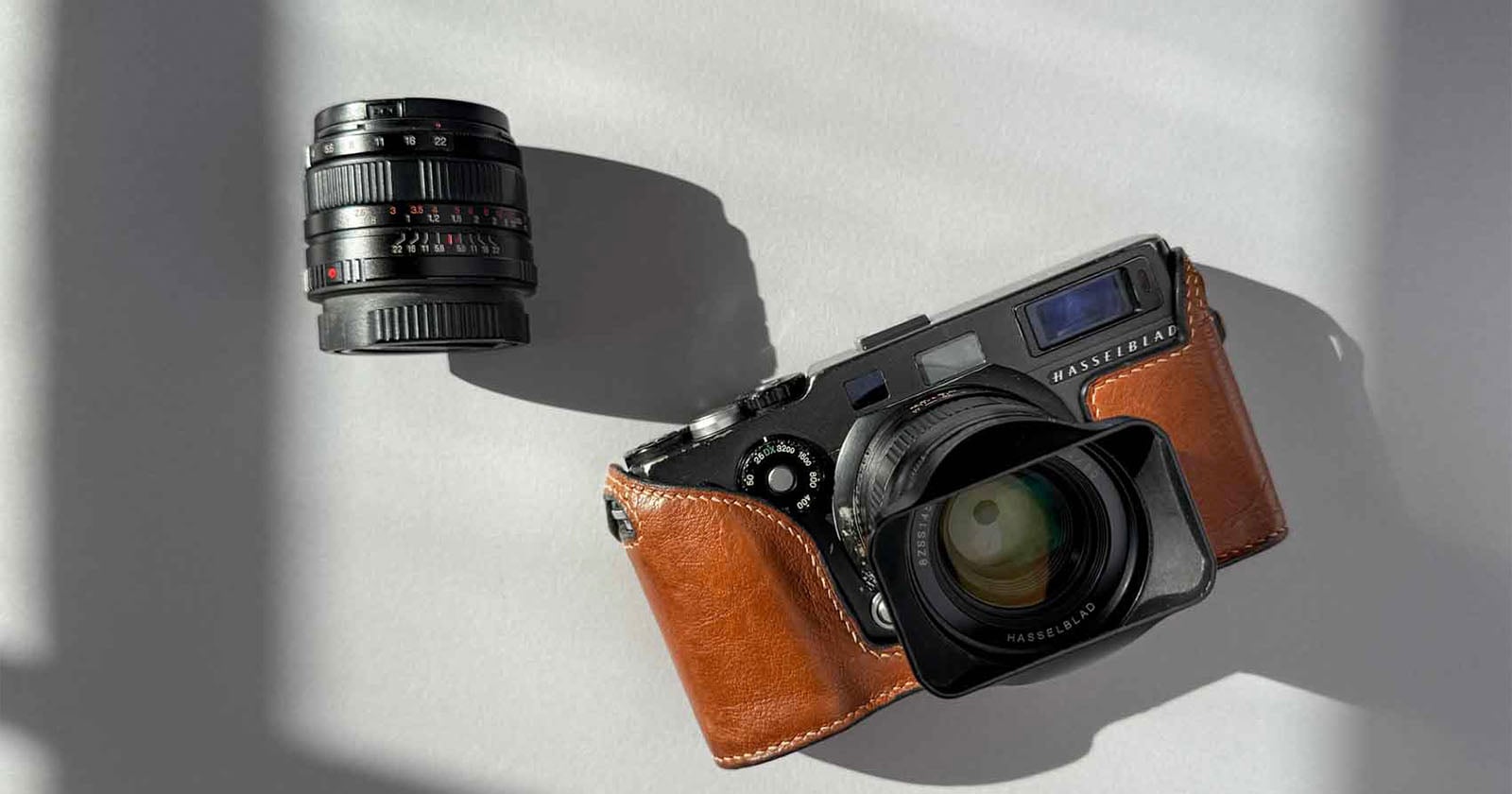
To keep the shoot focused, I kept the setup minimal. One camera, two lenses and one main film stock. I used the Hasselblad XPan with the 45mm f/4 and the 90mm f/4. The 45mm lens was my choice for context-driven frames because it is the widest option I have for that camera, and it gives a natural sense of space. The 90mm lens was for detail and separation. It isolates the subject and cleans up the background, even at modest apertures.
I loaded Kodak Portra 400 and carried a roll of faster film as a backup. The forecast promised sunshine, so I expected Portra 400 to be enough. Limiting myself to a single roll meant that every frame had to earn its place. Before pressing the shutter, I asked whether this angle and this moment really served the story.
The XPan meters from the center of the frame rather than as a tight spot reading, which can be tricky in high contrast conditions, especially if you want to optimize for one over the other. I chose to meter for the bright sunlight and let the shadows fall away. That decision gave the images a more cinematic editorial look with deep shadow and highlights with detail.
The alarm went off at five in the morning, and I made my way to the Barbican for our sunrise call time.
When we arrived, we walked a quick loop through the complex to understand the spaces we might use. I knew the light would not be ideal everywhere, but I wanted to feel how it moved between the buildings and where it might create narrow pools or streaks of sun. In the early hours, the light shifts quickly, and that is even more obvious between tall structures.
I looked for locations where I could place Maud in the light and keep the surroundings mostly in shadow. That separation by light and dark reduced distractions and made her stand out clearly in the frame. The camera was slow, and so was I. There were many moments when she had to repeat the same movement a few times because I missed the exact moment or the leg position did not look right. She kept going without complaint, and I am sure her step count that morning was impressive.
At the beginning, my nerves were high. I was not sure I would come home with anything special. As the shoot progressed, my nerves calmed, and I accepted that it might or might not turn out as expected. Whatever the outcome was, it would have been one full of learning. We continued with trust and patience, and we found a rhythm together.
In total, I shot twenty frames. I did not love all of them, which is absolutely normal, but a few stood out and became the backbone of the series. For an editorial sequence, you usually want a mix of context, mid-distance, and close-up images, so I focused on building that structure.
The first key image I focused on was a wide contextual frame. I placed Maud to the side of the track with her upper body lit by the sun and her shadow falling sharply on the wall on the other side. You do not see the run in a literal way, but the activity is clear, and the intention behind the frame is immediately clear.
The second is a mid-distance image where Maud stands still, looking into the distance, while a curved track leads up and away out of frame. That shape drew my eye immediately, and the width of the frame lets that curve lead the viewer naturally through the image.
The third is a close-up. By then, the sun had risen higher, which made even lighting on her face almost impossible. The roof of the building helped flag the sun initially, but at this point became a sun blocker. However, that slight unevenness helped the frame feel more natural and less controlled, imperfect because it was just a moment during the run caught on film. I asked her to reach for her glasses to give her more “body” and the composition more structure. On the XPan, close-ups can feel empty if the frame has too much space, so her arm and hand help fill the format and make her presence stronger.
Looking back, I saw that I had stayed close to the images I had planned, sometimes at the expense of experimentation. Whilst reviewing the negatives, I realized I did not explore motion blur as I should have. A few blurred frames might have added depth to the sequence. It is a lesson I’ve learned and something that I need to start exploring with the XPan.
The shoot reminded me that an editorial series is not about one perfect moment. It is about a small narrative built from several images that all serve the same idea.
It also showed me how valuable a more detailed location scout could be in a large place like the Barbican. Understanding how the light falls before the shoot day would have saved time and eased some of the pressure.
Most of all, this project confirmed how much I enjoy creating concepts with people while still leaving room to improvise. Planning a shoot is essential for me, but if I lock in every detail, my joy of creativity through discovery can disappear. I am happy with what we created that morning. There are things I will do differently next time, and that is exactly why portfolio shoots like this matter; it creates room for growth.