The Myth of Intent in Photography
The world of photography is currently navigating a crisis of authenticity. AI-generated images are now indistinguishable from photographs. Judges and audiences alike can’t tell the difference. Even experts are getting it wrong.
The instinct is to panic, to argue that if we can no longer verify that a human was “there,” then photography itself is losing its meaning. But that instinct assumes something deeper: that the value of a photograph lives in the moment it was made.
The idea that a great photograph is created in a single, perfectly-timed instant is both deeply appealing and fundamentally wrong. Stepping into the world and courting serendipity may yield a beautiful accident, but pressing the shutter is only the beginning. The real work begins later, when those frames return from the field to the sorting table, where photography becomes art.
In my house, the sorting table is Lightroom Classic, and the act of sorting is fueled by two things: whiskey (for my wife) and mezcal (for me).
We sit together in front of the glowing grid of images and sift through the raw files, flagging the frames that catch our eye. I explain why some of them — the intentionally-crafted ones — are worthy, and the others are just happy accidents, worthy of deletion.
“It doesn’t matter whether you intended it to look this way or not,” my wife says. “It’s good! That’s what matters.”
It took me a while to realize that (as usual) my wife is right, and Sony agrees with her.
Last month, Elle Leontiev won the 2026 Sony World Photography Awards, claiming both the Portrait and Open Photographer of the Year categories. She was on a documentary assignment in Vanuatu when she took an unplanned detour to Mount Yasur and serendipitously met Phillip Yamah, a self-taught volcanologist who navigates the scorching ash plains barefoot. She asked him to pose for a portrait, and what resulted was the winning photo.
A post shared by ELLE LEO | Sony Open Photographer Of The Year 2026 (@elle_tieva_)
A post shared by World Photography Organisation (@worldphotoorg)
What makes this story relevant is the fact that Leontiev was “shooting entirely blind.” According to this account, an electricity shortage in a nearby village rendered her Sony A7 III screens and digital interface inoperable. Relying completely on the beep of her autofocus sensor, she pressed the shutter button, not knowing what (if anything) would result.
Rather than seeing the singular moment while photographing, Leontiev found it later when she downloaded the files and recognized the beauty of the winning frame. She and the broken camera gathered the data blindly; the photographer decided what was art at the sorting table.
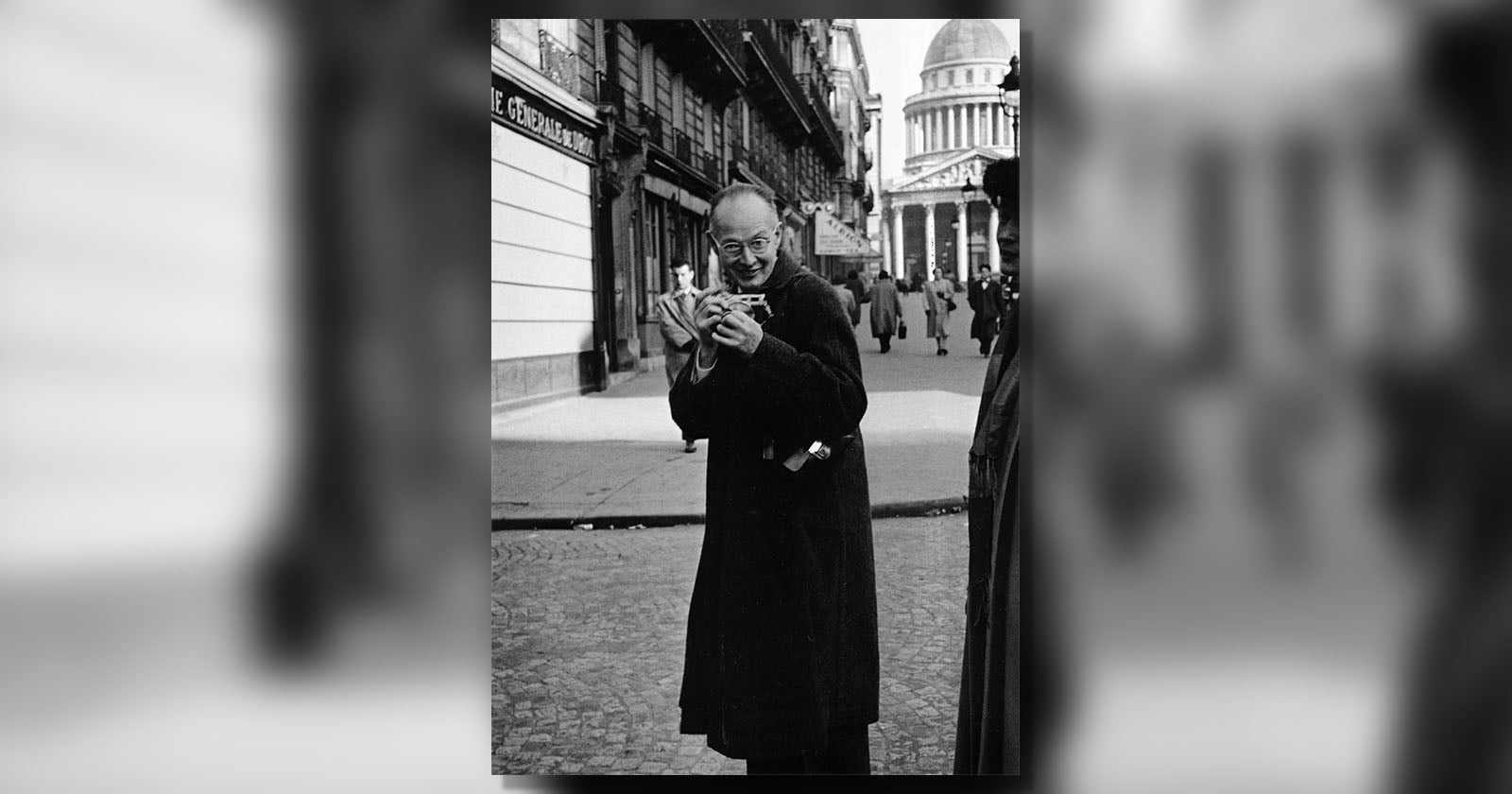
For almost 75 years, the photographic community has defended the romantic myth that if you did not consciously intend the image at the exact fraction of a second the physical reflex occurred, you merely got lucky; you did not create art. Henri Cartier-Bresson championed this myth with the “Decisive Moment,” which he defined as “the simultaneous recognition, in a fraction of a second, of the significance of an event as well as of a precise organization of forms.”
We treat this philosophy as gospel, but the intense irony of the “Decisive Moment” is that the man who demanded perfection at the click was, in his finest moment, working without the benefit of sight.
When photographing Behind the Gare Saint-Lazare, a wooden barricade blocked Cartier-Bresson from seeing the frame. He shoved his Leica’s lens through a gap in the planks. The space was too narrow to fit his eye to the viewfinder, so he pressed the shutter blindly, admitting that he never saw the posters behind the leaping man until he developed the negative. The visual rhyme of the dancer on the wall — the exact geometric miracle that grants the image its immortality — only revealed itself afterward. He did not compose the image in the viewfinder. He recognized it in the darkroom.
If even the most celebrated example of perfect timing depends on recognition after the fact, then doesn’t the premise of the decisive moment entirely collapse?
To dismantle the romanticism of the single click, we need only look at Magnum Contact Sheets, an unedited collection that demystifies the definitive frame. These contact sheets reveal the messy, iterative process of creating art. Far from conjuring a singular, flawless instant, the sheets reveal an accumulated sequence of near-misses. What the camera gathers, the artist must later refine.
In uncontrolled environments, we act as foragers, gathering what the environment offers. But successful foraging requires knowledge, intuition, and, importantly, being in the right place. A skilled forager knows where to search for its bounty. They know not to pick every mushroom; as best they can, they discern food from poison.
Photographers navigate the unpredictable, accompanied by their camera, which remains a blind tool — a basket holding whatever the forager places into it. Anticipating the leaping man, Cartier-Bresson pushed his Leica through a fence. The camera mechanically gathered the elements, but the recognition of the true art occurred later.
According to Ansel Adams, “Twelve significant photographs in any one year is a good crop.” Before his death, Adams curated only 126 images out of 40,000 or so negatives to represent his life’s work. He pre-visualized landscapes, metered light, calculated the Zone System, and generated tons of exposures annually, but he refused to elevate every frame to a photograph.
The necessity of curation is not a relic of the darkroom era; it is a modern mandate. In a massive study on “visual saturation,” researchers recently determined that AI now generates 34 million images a day. Moreover, the study concluded that “[n]either humans nor AI tools can reliably distinguish between real and fake images. The inability to distinguish between the two is becoming the norm.”
Boris Eldagsen proved this in 2023 with his submission to the Sony World Photography Awards. Titled Pseudomnesia: The Electrician, it won first prize in the Creative category. But, in a shocking twist, after the expert judges evaluated the portrait and proclaimed it the winner, Eldagsen refused the award, revealing that it was entirely AI-generated—a test to see if the establishment could detect the difference. They could not.
AI generates images without physical presence, but photography relies on a physical record. This kind of record is called “an indexical sign,” a physical trace left behind by a real event, like smoke from a fire or a track in the snow.
A camera records cause and effect. The light reflecting off Phillip Yamah on the volcano physically altered Leontiev’s sensor. Her photograph is the track in the snow.
AI leaves no tracks because it never stood in the snow. Researchers recently framed this distinction clearly: a photograph captures reality, while AI calculates probability. An algorithm simply mimics the look of reality. It borrows the aesthetic of the track, but it lacks the weight of the footprint.
For the forager, the physical act of “being there” is essential to gathering. But origin alone is not art. A track in the snow is merely evidence of passage. To find the art, we must take the basket’s bounty back to the sorting table. This is where the algorithm and the camera diverge. In order to complete the process, the artist must decide what stays and what goes.
I feel the weight of this new reality every time I sit down at the sorting table. I know that an algorithm just generated thousands of perfect images in the time it took me to upload mine to Lightroom. I often wonder what my singular point of view means in a world saturated by machine-generated images.
My ego fears irrelevance. But that fear assumes the value of my work lives in the click of the shutter. If the camera and the algorithm are both just rendering engines, then my point of view does not exist behind the lens; it exists in the edit.
The camera doesn’t create photographs. It collects them. What we call “the moment” is just raw material — one frame among multitudes. The real work starts afterward when we sort through the bounty and decide what to keep.
Discernment is what transforms a frame into a photograph, not the instant of exposure, but the act of recognition. The myth of intent asks us to believe that meaning must exist at the decisive moment. In reality, meaning is assigned later, when we encounter the image and decide that it matters.
The shutter records what happened. The photographer determines its value.
About the author: David M. M. Taffet is an award-winning photographer and a photographer for Mérida’s Dirección de Identidad y Cultura and Comité Permanente del Carnaval de Mérida. With a background in law, corporate restructuring, and building his own businesses, David has spent decades exploring the ethics of engagement while photographing in 54 countries. David advocates for ‘foraging’ over hunting to restore humanity to photography. You can view David’s work at www.invisibleman.photography and @invisiblemanphotography on Instagram.
The opinions expressed in this article are solely those of the author.