Making Peace With the Brutal Math of Photography
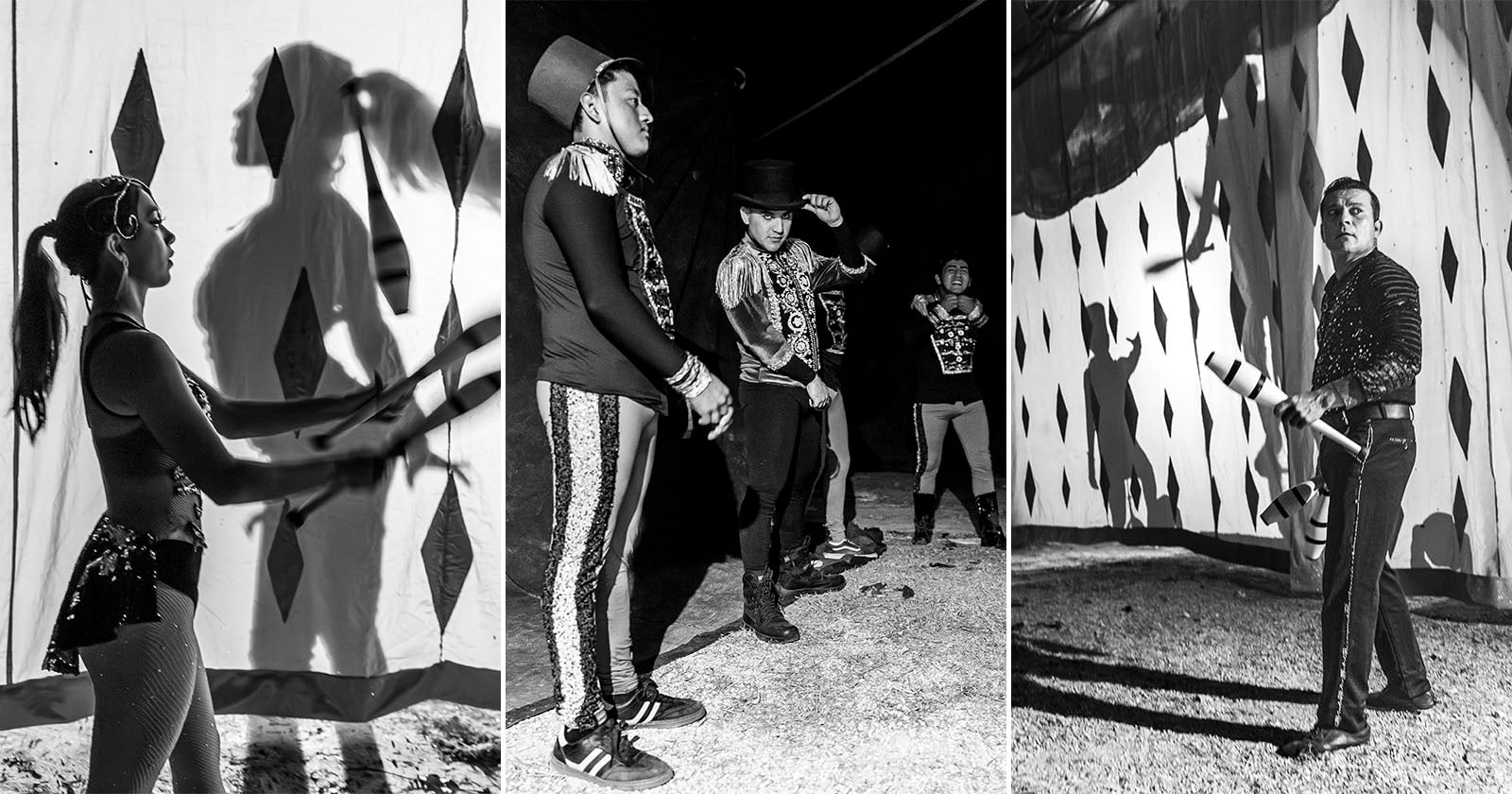
A camera projects an illusion of authority. It is easy to mistake the act of framing for the act of creation. We expect the lens to function as a paintbrush, assuming that technical mastery guarantees dominion over a scene. The prevailing mythology insists that vision alone bends reality, and that a trained eye can summon permanent order from spontaneous chaos. The vagaries of the environment dictate otherwise.
Outside the regulated order of a studio, the physical world refuses direction. Light fades, geometry collapses, and subjects move with indifference to the frame. To operate a camera in this space requires surrendering to the mathematics of chance. In uncontrolled settings, photographers are foragers scouring the wild in search of something spectacular and rare while accepting the likelihood of returning empty-handed.
I recently photographed behind the scenes of a traveling Mexican circus. Over the course of five shows, a lot went wrong. The first night, I accidentally set the incorrect exposure compensation, plunging most of the shadows into impossible-to-recover darkness and ruining all but a handful of photos. The second night, the fairgrounds experienced a power outage, and the circus itself went pitch black.
On the third day, I attended an afternoon and an evening show. In both instances, the photo gods blessed me, and everything aligned. I navigated the difficult light and shadow and returned with frames that felt worthy. I was proud. I felt like a master of my craft.
Then came the final night.
The circus moved to a different locale with a smaller tent that lacked some of what made the previous one such an interesting backdrop. The main performers had left for another city. This troupe was not as practiced and lacked the relationship chemistry of the regulars. The connection, energy, and aesthetics were off. Still, I pushed forward, struggling to photograph for three hours, convinced I could force a good image into existence.
I returned home with nearly a thousand frames, out of which only three emerged as de facto winners. I was depressed, angry, and entirely defeated.
While working through my Morning Pages the next day, the reality of the medium finally broke through my bruised ego. If I were a painter, I could choose the size and material of my canvas, select my brushes, purchase the exact paints I wanted, dictate the lighting, and meticulously control my subject. These artists enjoy much greater authorial control. While unforeseen circumstances may arise, the chaos of an uncooperative world is not so directly at fault for a poorly-executed painting.
But photographers operating in the unscripted world—regardless of their specific discipline—do not possess this level of authorial control over the medium. As I have written about in a previous PetaPixel article, we photographers are foragers. Other than our physical presence, the positioning of our feet, our lens’s focal length, the exposure triangle, and the placement of the frame, we cannot force the environment to bend to our will. We cannot regulate the light, the physical appearance of the subjects, the appeal of the background and foreground, or the ubiquitous presence of photobombers. To expect authorial control in an uncontrolled environment is an act of arrogance, at worst, and delusion, at best.
Historically, the art form has tried to obscure this truth behind the romantic idea, made famous by Henri Cartier-Bresson, of the “Decisive Moment” — an alignment of eye, heart, and mind. It is an appealing philosophy, but it conveniently ignores the mathematical improbability of serendipity.
In “Diana & Nikon“, Janet Malcolm addresses Cartier-Bresson directly, she noted that his timing actually owes a debt to Surrealism, a movement built on embracing the “found object” and the random accident. Malcolm argued that playing the omnipotent author is a sleight of hand, pointing out that “the photographer’s most important piece of equipment is not the camera but the accident.” She observed that even the greats are tethered to the whims of chance, noting that the camera routinely defies the photographer’s intent.
In his critiques of photographic meaning, Allan Sekula argued that elevating the street photographer to the status of a lone, controlling genius is a “romantic fiction.” It is an invention designed to elevate the medium to the status of painting, a fiction that conveniently ignores how photographers in uncontrolled environments remain captives to the spontaneity of their subjects.
When we strip away the romance, the photographers working in these chaotic spaces were not orchestrating the world; they were simply enduring it. When Garry Winogrand died, he left behind nearly 300,000 unedited exposures and 2,500 unprocessed rolls of film. His archive proves the stoic reality of the street: to find a few dozen masterpieces, he had to process well over half a million failures.
Years later, photography curator John Szarkowski openly confessed the mathematical absurdity of Winogrand’s later output. In Figments from the Real World, Szarkowski noted that Winogrand’s camera had essentially become a machine that “shot blanks” as his hit rate dropped to near zero against the volume of the exposures.
Critic Geoff Dyer expanded on this vulnerability in “The Ongoing Moment”, asserting that Winogrand wasn’t composing frames in the traditional sense; he was surrendering to probability, shooting merely “to see what things looked like photographed.” Some contemporary critics attempt to rescue Winogrand’s late-stage output by framing it as a deliberate experiment in pushing the limits of visual chaos. But stripping away the gloss reveals a simpler truth: the experiment was a failure. It was the analog equivalent of “spraying and praying”—an ultimate surrender of authorship to the odds of aligned serendipity.
Some artists recognize this mathematical absurdity and simply refuse to play the odds. Jeff Wall began his career working in traditional documentary styles, but eventually abandoned the unpredictable street. Frustrated by the high failure rate of hunting for images, Wall pivoted to what he calls “cinematography.” In his essay “Marks of Indifference,” Wall rejected the documentary tradition, explaining, “I wanted to compose… I realized I couldn’t be a photographer in the traditional sense. I had to construct.” He now builds elaborate sets, controls the weather with rain machines, and hires actors, demanding the authorial control of a classical painter.
Similarly, Philip-Lorca diCorcia grew so exhausted by the uncooperative nature of the world that he decided to forcefully impose the studio onto the street. For his Heads series, he rigged strobe lights to scaffolding in Times Square to dictate the exact lighting of random pedestrians. DiCorcia openly admitted his frustration with serendipity, stating his desire was to “control the uncontrollable” and enforce a predetermined, artificial structure onto a chaotic environment.
Wall and diCorcia refused to rely on probability. Tired of searching in the dark, they effectively built their own streetlamps.
This points directly to the classic psychological joke known as the “Drunkard’s Search.” A policeman finds a drunk man crawling on his hands and knees under a streetlight.
“What are you doing?” the policeman asks.
“I’m looking for my keys,” the man replies.
They search together for several minutes. Finally, the policeman asks, “Are you sure you lost them right here?”
“No,” the man says. “I dropped them in the dark alley around the corner.”
Incredulous, the policeman asks, “Then why are you looking here?”
“Because,” the drunk replies, “the light is better here.”
The studio is the streetlamp. It is safe, the light is perfect, and the variables are drastically reduced. But as documentary photographers, we choose the dark alley. We know the environment is menacing, the light is unstable, and the likelihood of finding anything is low. We search there anyway, because we know the raw, unvarnished reward we are looking for does not exist under the safe glow of the lamp.
In his Nicomachean Ethics, Aristotle provides the perfect framework for this mindset. He distinguishes true courage from mere rashness. The fool who rushes into a burning building because he is ignorant of the heat is not courageous; he is just a fool. True courage requires full knowledge of the risks. It is the act of looking directly at the likelihood of pain, failure, and defeat, and choosing to step forward anyway because the objective is noble.
Going out to photograph the world is an act of Aristotelian courage. In Beauty in Photography, Robert Adams argues that the photographer’s fundamental task is to face the uncooperative chaos of the physical world and attempt to “wrest” a momentary order from it. Adams frames this pursuit not merely as a technical exercise, but as a moral act of endurance, a refusal to surrender to despair despite the odds of failure.
We are not creating the gems; we are tenacious foragers of serendipity, sifting through the chaos. We intellectually appreciate how impossible it is to force the world into flawless frames. We know we will likely return with nothing. But the reward — that singular, impossible frame where the universe aligns in our favor –matters more than the certainty of our frustration.
My photographs from the final night at the circus were terrible. The stream ran dry, and I came home empty-handed. But instead of mourning the frames that did not work, I am choosing to celebrate the few frames that did work and the courage it took to go out and bring my best to the dirt floor of the tent. I have mastered the things I can control in a world I cannot.
And tomorrow, I will go back out, because this is not a studio. This is life. The only thing a true forager can control is the resolve to step back into the chaos. We master the instrument, we accept the impossible mathematics of the world, and we choose to seek serendipity anyway.
About the Author: David M. M. Taffet is an award-winning photographer and an official photographer for the Dirección de Identidad y Cultura in Mérida, México. With a background in law and corporate restructuring, David has spent decades exploring the ethics of engagement while photographing in 54 countries. David advocates for ‘foraging’ over hunting to restore humanity to photography. You can view David’s work at www.invisibleman.photography and @invisiblemanphotography on Instagram.
Image credits: David M. M. Taffet
The opinions expressed in this article are solely those of the author.