Light and Photography: How Light Travels Through Your Lens
Photography has everything to do with light. Therefore, the more we know how it behaves and interacts with our equipment, the greater the chance of getting a successful photo.
This time, we are going to look at your camera and lens and consider the factors that go into their design and construction.
If you look at the cost of lenses, they vary enormously. Generally, the more you pay, the better the lens’s optical performance. So, what is the difference in performance down to?
The difference we usually consider is the lens’s brightness. Bright lenses give us shallower depths of field and enable faster shutter speeds, which is why they are sometimes called fast lenses. A generalization is that the wider the aperture, the better the lens, and the more expensive it becomes. That isn’t always true. The ubiquitous “Nifty Fifty” 50mm f/1.8 lenses are cheap, impressively sharp, and deliver attractive results, but they’re not without flaws.
Great lens performance relies on absolute precision to give sharp images with accurate colour rendering, good contrast, and no artefacts. Consequently, they cost more. However, it’s important to realize that no lens is faultless.
Even if you cannot afford the highest-quality lenses, recent improvements in some software can yield far better results from lower-quality glass than was once possible.
Comprising a complex array of individual elements, lenses collect light and focus it on the sensor or film. Every time light passes through an element, there is a loss or distortion of the light. Consequently, like most things in photography, lens designs are a compromise. While intended to address issues, each corrective measure introduces another attribute that is, most often, unwanted.
The newest technologies and improved designs are helping to minimize those issues. However, for light to reach your sensor with minimal error, there are hurdles to overcome.
As light passes through the lens, it is bent by each element. The bending of light is called refraction, and it is used to create a precise image on the sensor or film. All optical devices rely on refraction.
Refraction happens when light moves from one medium to another; we have all noticed that a spoon appears bent when partially submerged in a glass of water. That is because light travels at different speeds in different media.
In a vacuum, it travels at 299,792,458 m/s (meters per second). In the air, it is 89,911 m/s slower.
Water slows light down a lot more. It’s a further 74,702,547 m/s slower to 225,000,000 m/s. In low-refractive-index glass, it’s travelling at around 200,000,000 m/s; in high-index glass, at 158,000,000 m/s. That’s 52.7% slower than in a vacuum.
One of the issues lens designers must address is how light splits as it bends. What we perceive as white light is a mixture of different visible wavelengths. As it changes medium from air to glass, light bends and splits into its component colours: red, orange, yellow, green, blue, indigo, and violet. We commonly see these colors in raindrops when they are diffracted. Light can also be split unwantedly by a poorly manufactured lens, resulting in color fringes around high-contrast edges. That artefact is known as chromatic aberration.
To address this, manufacturers use very top-quality glass with a high refractive index and low dispersion. That HR glass bends light more than glass with a low refractive index. Then, low-dispersion glass helps stop the light from splitting into its component colors as it bends. If you see terms like ED (Nikon, Fujifilm, OM System), LD (Tamron, Pentax), UD (Canon), and SLD (Sigma), they refer to specific types of glass elements. Each element is shaped, ground, and polished to a very high level of precision.
If you look at glass, you see it reflect light. For lens manufacturers, that is a problem. The more light that is reflected, the less passes through the lens to the camera. Therefore, they apply nano-coatings to the lenses. These microscopically thin layers reduce reflections from the element’s surface, thereby improving light transmission. Those nano coatings also help improve contrast and minimize lens flare and ghosting caused by stray light within the lens.
Even with those coatings, every air-glass interface loses some light. So, if possible, lenses should have fewer elements. In addition to chromatic aberrations, lens flare, and ghosting, as mentioned earlier, several other common distortions must be addressed by lens manufacturers. Therefore, some extra elements become essential.
Often, lens designers include aspherical elements to address a range of issues. Shaped precisely, those high-quality elements, with surfaces that are not perfectly spherical, are the antidote to the aberrations that can manifest in images that spherical surfaces cannot fix.
Spherical aberration is a fault that can cause softness around the frame edges, especially at wide apertures. It results in a loss of contrast in an image. Undercorrection can produce soft-looking images, though this can sometimes be desirable, say, in portrait lenses. Meanwhile, overcorrection can lead to harsh-looking results and either barrel or pincushion distortion.
These result from uneven magnification in the frame. Common with wide-angle lenses, barrel distortion causes straight lines to appear curved outwards in the middle.
Meanwhile, telephoto lenses are more likely to produce pin cushioning, in which straight lines bow inward.
This is an optical aberration that causes light sources near the edges of the frame to have smeared points with a directional “tail” that looks like little comets or sometimes bird‑wing shapes. It’s a design fault caused primarily by an asymmetry in how the lens refracts light from the periphery, leading to magnification that varies between the center and the edges of the lens.
Astigmatism occurs when the lens can’t bring light from off‑centre parts of a scene to a single sharp point on the sensor. Instead, the light focuses in two different directions. Then, small points of light look stretched or smeared, especially at the edges of the frame.
When the lens focuses on a curved plane rather than a flat one, this is known as field curvature. It is unwanted because your camera’s sensor is flat. With it, the corners of the frame become soft simply because the area of best focus isn’t flat. With field curvature, you can choose to get either the centre or the corners sharp, but not at the same time.
This is where light drops off in the corners of the lens. This is more likely to happen with wide-angle lenses.
Although having fewer elements is advantageous, complex zooms require more glass. However, better designs and technology still help optimise layouts to minimise unnecessary surfaces.
Those lens elements need precise mechanical alignment within the barrel, which is also designed to reflect as little light as possible. Barrels have ridged, matte-black coatings with flocked or micro-textured surfaces that absorb rather than reflect light inside the lens.
Although not directly related to the transmission of light, weather sealing and fluorine coatings on the front element don’t improve a new lens’s optical performance, they help in the long term by keeping the lens clean.
High-quality zooms, besides being brighter, use clever engineering to maintain a fixed F-number across the zoom range.
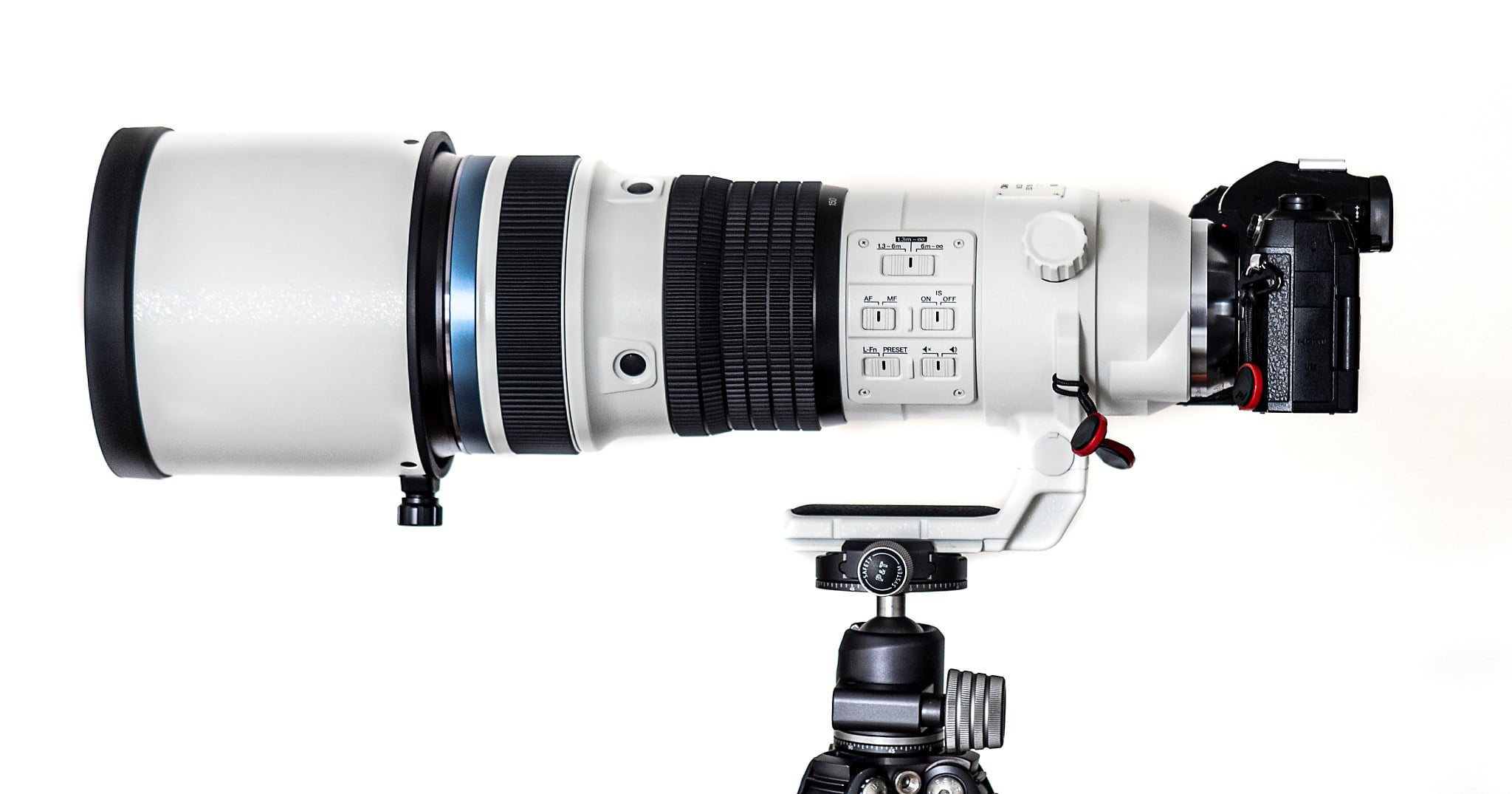
Better lenses will have additional features such as programmable function buttons, focus presets, built-in teleconverters, and image stabilisation. They may also feature an all-metal construction, maybe using a very light but strong technical alloy.
Inside the lens are the aperture blades that open and close to let in different qualities of light. These can vary in number and shape. Besides changing exposure, the aperture size affects depth of field. However, there is another way they affect your photo as well.
Many older lenses had just a few straight blades. New, top-quality lenses have more blades with rounded edges. The shape and number of the blades affect how the bokeh looks. That means the shape of the out-of-focus points of light changes. With a six-bladed lens, those balls of light become hexagonal. Meanwhile, a lens with multiple rounded blades will produce circles and a smoother blur. The number of blades will also affect starbursts, for example, from a sunrise.
Although the current trend is to praise the latter, it is subjective; many people like the bokeh produced by vintage lenses with six blades.
Every situation produces different amounts of light, either direct or reflected, from diverse directions. To cope with that, your camera and lens will be adaptable to different situations. However, to misquote George Orwell, all cameras are versatile, but some are more versatile than others.
It is nice to have a new camera. The features in the latest top models that allow, among other things, shooting at higher ISOs, will trickle down to the mid-range models. However, the equipment that makes the biggest difference in a photograph is the lens. Investing in a bright, sharp lens with minimal distortion and artifacts, and superb microcontrast (the tiny variations within boundaries between light and dark areas that make textures look crisp, three‑dimensional, and lifelike), makes the most difference.
In the next article of this series, we look at color, intensity (luminance), and direction.