Webb's Latest Photos Are Among its Most Incredible Yet
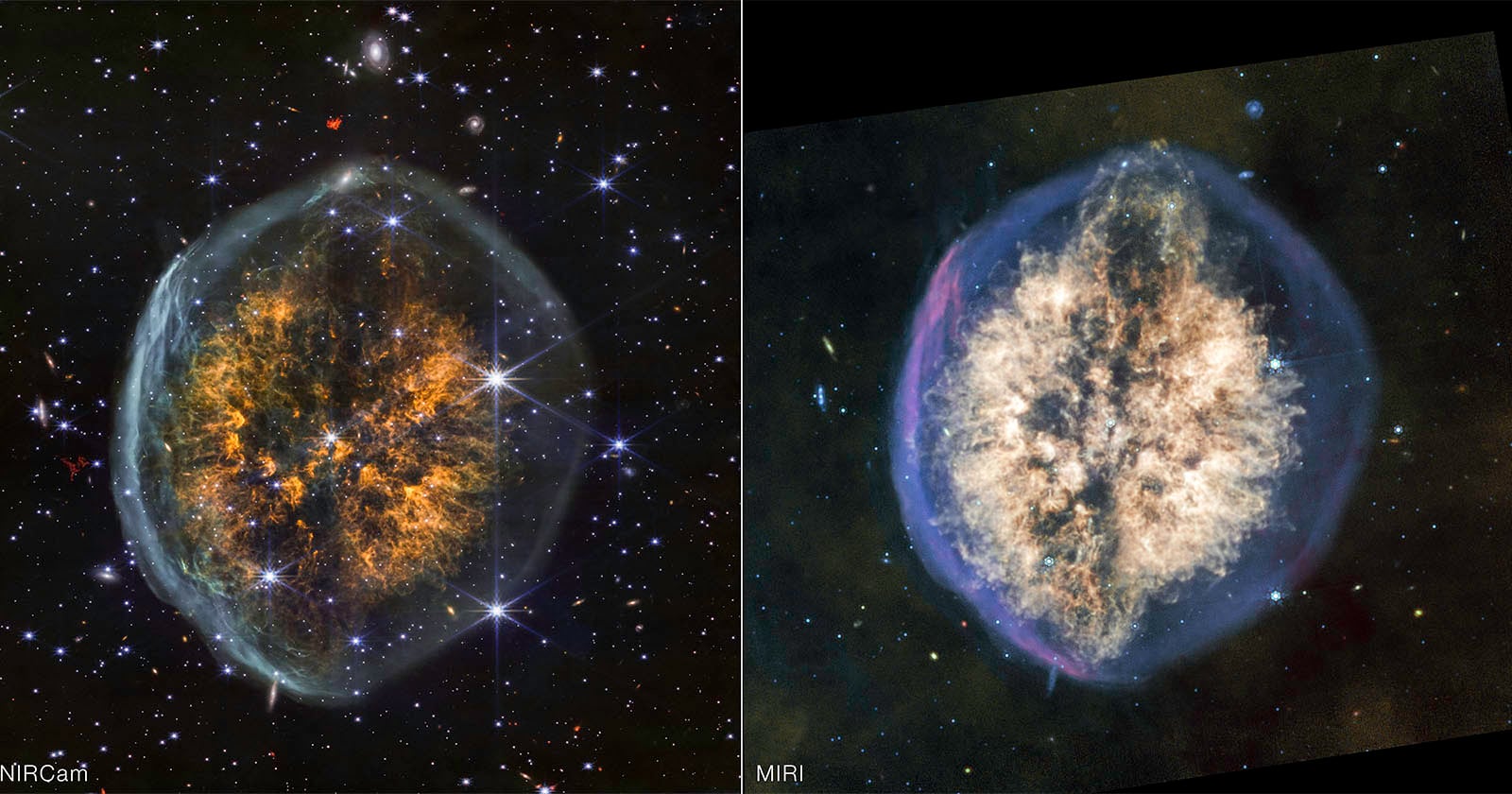
The James Webb Space Telescope (JWST) has captured plenty of incredible, jaw-dropping photos since its first five images were published in July 2022. But few have been quite as spectacular and otherworldly as Webb’s latest shots of Nebula PMR 1, a rarely-studied nebula nicknamed the “Exposed Cranium.”
This nebula was first captured in infrared light by one of Webb’s predecessors, NASA’s now-retired Spitzer Space Telescope, over a decade ago. Armed with billions of dollars of sophisticated technology, JWST has unveiled the Exposed Cranium nebula in exquisite detail using two of its imaging instruments, NIRCam (Near-Infrared Camera) and MIRI (Mid-Infrared Instrument).
The two photos show the nebula in dramatically different ways. NIRCam’s shot shows the nebula in a way not unlike the Palantíri that Sauron used in “The Lord of the Rings.” Meanwhile, MIRI’s portrait of the Exposed Cranium nebula is much brighter, revealing different details inside the nebula. In both cases, the photos showcase incredible resolution.
“The nebula appears to have distinct regions that capture different phases of its evolution — an outer shell of gas that was blown off first and consists mostly of hydrogen, and an inner cloud with more structure that contains a mix of different gases,” NASA explains. “Both Webb’s NIRCam (Near-Infrared Camera) and MIRI (Mid-Infrared Instrument) show a distinctive dark lane running vertically through the middle of the nebula that defines its brain-like look of left and right hemispheres.”
Thanks to Webb’s resolution, scientists have determined that PMR 1 is “being created by a star near the end of its fuel-burning ‘life.'”
When stars are nearing the end of their lives, they expel their outer layers. This dynamic, often beautiful process, is relatively short-lived on the cosmic timescale. The James Webb Space Telescope has captured two equally interesting, albeit different portraits of this star’s march toward death.
Scientists aren’t yet sure of the star’s mass, so they can’t predict exactly how the star will ultimately die. If it has sufficient mass, it will explode in a supernova. But if it’s less massive, more like the Sun, it will continually shed layers until only its core remains — a dense white dwarf that cools off “over eons.”
Image credits: NASA, ESA, CSA, STScI; Image Processing: Joseph DePasquale (STScI)