DIY Digital Iris Animates and Customizes Lens Bokeh
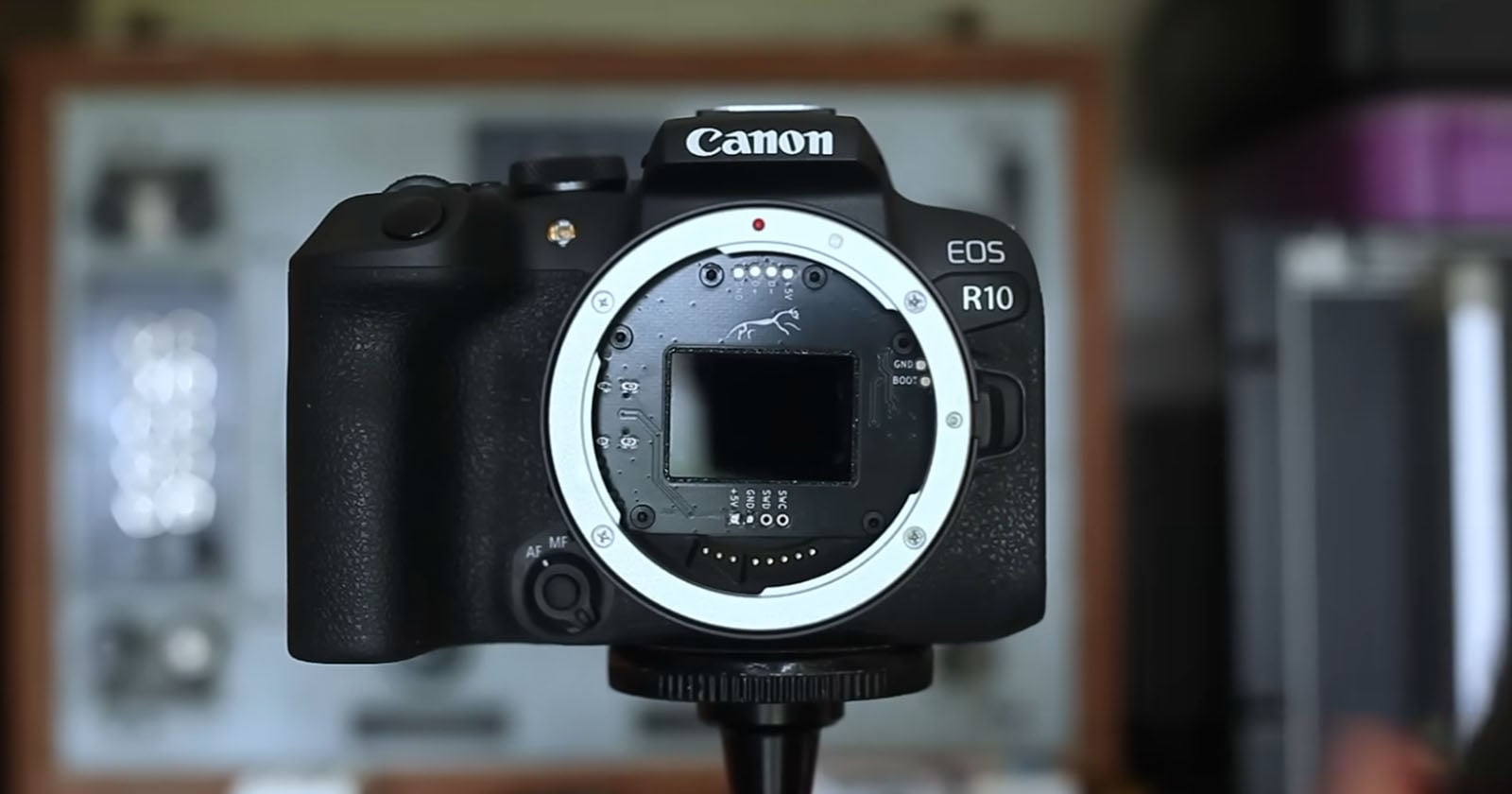
Adapters to use DSLR lenses on modern mirrorless cameras are very common parts of photography kits. They are extremely useful tools that enable photographers to use their existing, older lenses on new mirrorless cameras. However, as New Zealand builder James, who goes by Ancient on YouTube, shows, these adapters can be so much more and capture photos and videos that would otherwise be impossible.
As Ancient James shows in the video above with his Canon EF-EOS R adapter, which lets Canon EOS R owners use Canon EF DSLR lenses on their Canon mirrorless cameras, there is quite a bit of space between the EF lens on the front and the EOS R camera image sensor at the back of the adapter. Normally, there is nothing in this gap; the light travels through the lens, the gap, and hits the image sensor, meaning the EF lens works essentially the same on a mirrorless camera as it does on a DSLR.
James had the idea, what if he put something in this gap? Enter the Digital Iris, a programmable transmissive LCD that “[inserts] digital effects into an otherwise purely optical pipeline.”
As Ancient James demonstrates in the video above, it’s possible to create unique iris shapes using this transmissive LCD. Photographers may be familiar with this concept, as Lensbaby has offered numerous lenses over the years that support customizable bokeh shapes using inserts, letting photographers turn out-of-focus point light sources into shapes like stars and hearts. However, what makes Ancient James’ Digital Iris so different and exciting is that using new shapes is as simple as installing ffects on the Digital Iris’ tiny onboard computer.
Beyond that, these effects can also be animated and manually controlled in real time, enabling the use of changing effects during video recording. It also means that different parts of the light field can be precisely darkened during shooting, enabling the Digital Iris to capture parallax effect wobbles, like a “wigglegram.” Normally, a wigglegram relies on multiple lenses capturing shots of the same scene from slightly different angles, but since the Digital Iris can control the light hitting the sensor, it can achieve a similar effect by simulating multiple lens angles in quick succession.
It’s a relatively complex but very interesting DIY project. Ancient James has uploaded all the required files to Github, and the Digital Iris, as he built it, runs on an RP2040 running Micropython 1.27 with an 84×48 pixel PCD8544 LCD. He has also uploaded some different aperture files to Github. It would be very cool to see something like this as a commercially available product for those who aren’t able to build it for themselves.
Image credits: Ancient James